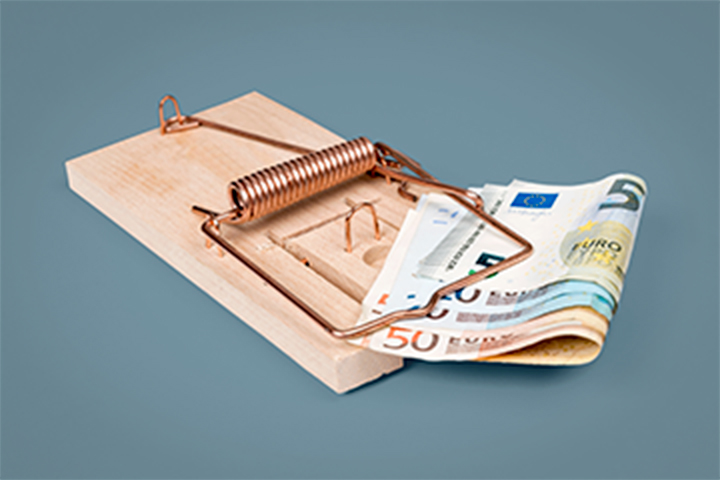
Investing funds without any risk may sound impossible, but…


Keytrade Bank
keytradebank.be
January 24, 2026
(updated September 14, 2026)
3 minutes to read
Have you ever delved into the huge number of share prices, but felt the threshold was still too high to start investing? The risks of investing may still put you off a little at the moment. And that's a good reflex to have, as investing will always be synonymous with taking risks. The good news is that with a solid plan in place, you can try to mitigate them as much as possible. We'll help you take that final important step.
Why investing always involves risk
As soon as you start investing, your share will enter a world of market movements and fluctuating prices. Each and every share is sensitive to what is happening in the world – and the global economy, as well as everything that affects the economy, too.
In other words, the stock market never stands still, and nor do your investments. The value of your investments can rise sharply all of a sudden, but can also plunge in a short period of time. However, that's not a reason to shy away from the stock market. As long as you remain aware of the risks, you can adjust your investment strategy accordingly.
What are the risks of investing?
That said, there's no single general risk that investors may face. There are several forms of risk, and some can be managed better than others.
Market risk – the power of emotion
The stock market world reacts strongly to news, figures and… emotions. If investors suddenly become more pessimistic due to an announcement by a company, sector federation or world leader (there are enough recent examples), prices tend to fall. Even if the share price in question has been doing well for a long period of time.
Hopeful news or announcements of major investments can have a positive effect on a share price. Market risk may be the most obvious and, at the same time, the most inevitable risk.
Interest rate risk – the impact of rising or falling market interest rates
If you invest in bonds, you will receive a return in the form of interest. The amount of the interest will depend on the overall market interest rate. If the market interest rate rises, the price and value of your bonds may fall.
However, traditional individual shares can also be subject to fluctuating market interest rates. Higher interest rates make loans more expensive for companies, meaning they have to incur more costs and therefore potentially generate less profit – and share value.
Reinvestment risk – no two investments are the same
You sell (part of) your investment to invest in another product or sector. In this case, you should start with a blank slate. A new investment comes with new conditions and different potential returns; in short, it's a completely different scenario. It can also come with certain risks.
Inflation risk – when money is worth less
Rising inflation affects your purchasing power, even if your money is sitting safely in a savings account. As an example, what you can buy today for €100 may cost €105 next year. Your money is therefore worth less.
Inflation can also affect your return on investment. This will be reflected in your investment portfolio during periods of high inflation.
Liquidity risk – not all investment products are equally sought-after
Some investments cannot simply be sold straight away, while others can. Shares in a small, local, niche company, for example, may have few buyers or sellers and they may take longer to move than a more popular share – such as listed shares or ETFs.
There's more…
We haven't yet reached the end of the list, which includes bankruptcy risks, economic risks, geographical risks and even psychological risks. The more you are aware of what can affect your investments, the more conscious and therefore better decisions you can take to respond in the future.
Be sure to read more about all the potential risks involved in investing here.
Is it possible to mitigate the investment risks?
As we've mentioned, you can never eliminate risks entirely, but you can try to minimise them by spreading your investments across a range of investment products, sectors, stock market indices and regions, to name but a few. Diversifying your investments also means you can soften the blow of an adverse event.
Spreading out when you enter the market can also help, as it is a good idea to opt for monthly deposits instead of investing a large amount in one go. Doing so allows you to avoid one wrong decision making a big dent in your portfolio, and you even out the impact of fluctuations over time.
"Risk is different for everyone"
"The most important thing for any investor is to avoid a permanent loss of capital caused by selling a share when its price is at its absolute lowest. This is usually caused by stress, panicking or lack of sleep; emotion, in other words."
"Aside from all of this, investment risks are, above all else, relative. A novice investor may find investing a large amount straight away a huge risk, for example, while several studies have shown that going all-in, as it were, has a more positive effect on returns than diversifying your investments. What would you do if you received an inheritance or a bonus at work all of a sudden?"
"On the other hand, many novice investors don't have large amounts to invest, which means they have no choice but to go for diversified investments. Taking risk is something that's unique to each individual investor."
"The same applies when trying to time the market. It has been proven, for example, that buying shares at their price peak returns better results than simply buying at random. Are novice investors willing and able to take that risk, though? Here, it's important for investors to know that 'momentum' can also build over a longer period of time than just one day. As an example, the gold price has been rising sharply for the last year, which means it has had momentum for a while and, in turn, limits the risk."
"To sum up, emotion and risk are inextricably linked. As a result, even novice investors can bring professional traders back down to earth with the right strategy and by paying sufficient attention to potential risks."
Geert Van Herck, Chief Strategist at Keytrade Bank
What if something goes wrong?
No matter how well you prepare to become a successful investor, a risk will lead to an actual loss at some point – and that's something even the Warren Buffets of this world agree on. Much will depend on how you deal with that as a novice or experienced investor, however.
Let's look at a simple example. Imagine you buy shares for €1,000. After one year, the shares are only worth €900. That means you've suffered a 10% loss in a relatively short period of time. You could panic and sell them straight away, or you could wait. As we've said, the market is always going up and down. The longer you let your investment work for you, the greater the chance you have of it going back into positive figures.
Those who are aware of the risks are less afraid of downward movements, but aren't also tempted to celebrate too quickly, either. Adopting such an approach means investing remains a long-term story.
Are you a risk, too?
Finally, your own personality also plays a major role in whether or not you take investment risks. How well do you know yourself?
- Are you more of a defensive, neutral or offensive investor?
- Do you prefer to invest in high-risk, individual, niche shares or investment products such as crypto that offer a potentially higher return?
- Or do you prefer to play it safe and opt for investment products with a lower but more stable return, such as ETFs or bonds?
Whichever option you choose, you must first have your risk profile established before making your first investment. The MiFID test allows you to determine the following:
- What your investment objectives are; in other words, why you are investing
- What your financial situation and outlook are
- How much investment experience you already have
- How you would react to certain stock market movements
- And more
Getting to know yourself better as an investor is therefore a crucial part of learning how to manage investment risks better.
Five ways to manage investment risks smartly
Although risk is part of investing, it shouldn't cause you to freeze. Here are five tips to help you:
- Know what you're buying: Dive into the language used in the world of investing, learn how specific investment products work and know exactly what you're investing in.
- Think long-term: Remember that price fluctuations are part of the game and realise that time can also work to your advantage.
- Also consider diversified investments: Spreading your investments will make one disappointing return less impactful.
- Stay calm: Emotion is a poor adviser, both when it comes to losses and good returns. Always try to look at the bigger picture.
- Learn from reliable sources: Follow the latest news about your investment products through stock market experts and more. The Financial Services and Markets Authority (FSMA) website always contains the latest warnings and information on risks for each product.
Learn tips and tricks of investing with Keytrade Bank
Would you like to get to know the world of investing at your own pace? At Keytrade Bank, you've come to the right place for attractive investment products as well as the latest stock market news and investment information to help you stay up to date.